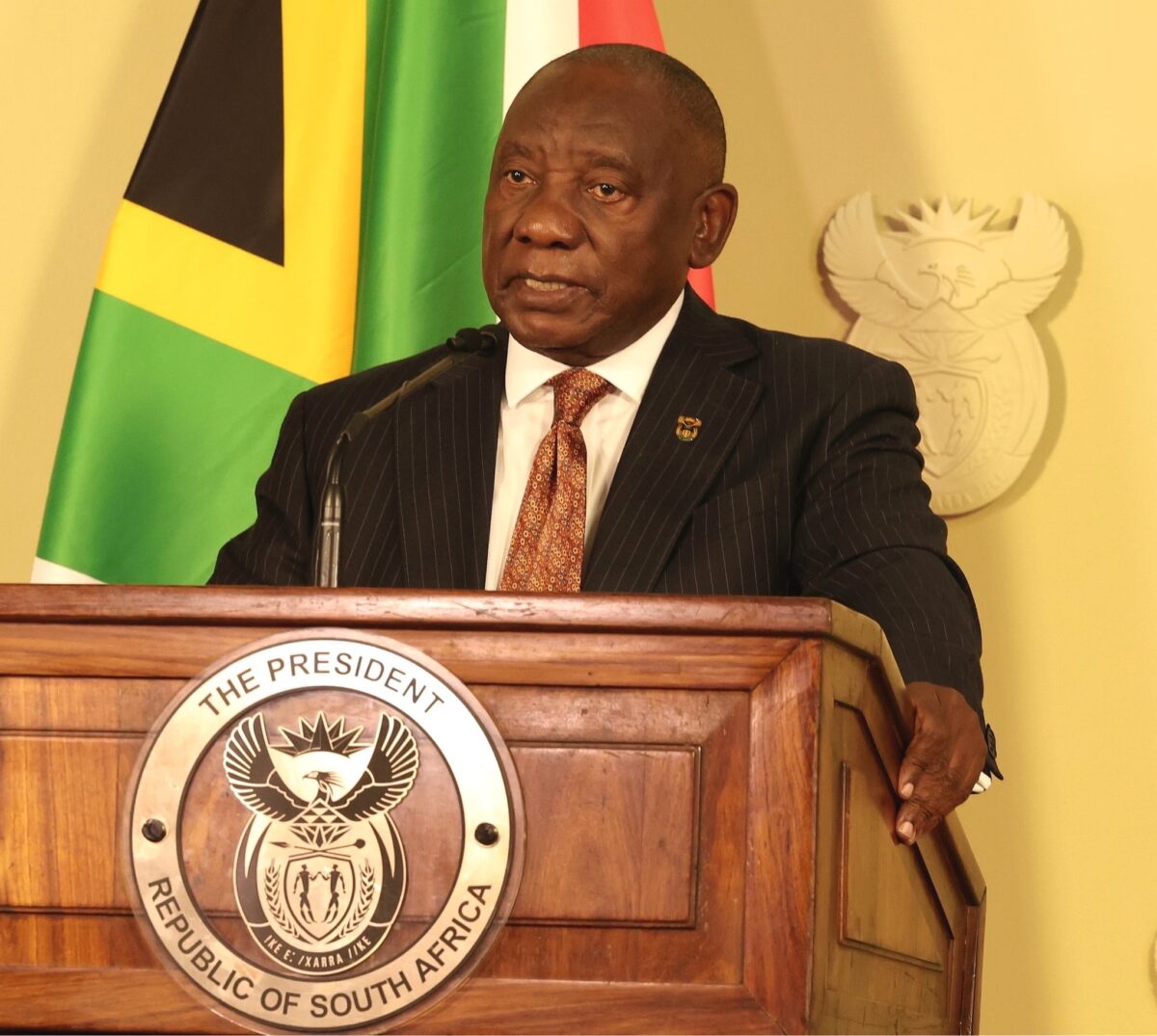
PRETORIA – South African President Cyril Ramaphosa on Sunday night addressed his nation on illegal immigration, acknowledging public frustration while warning against vigilante action and xenophobic violence.
Ramaphosa outlined a sweeping package of enforcement measures, his most detailed response yet to a crisis that has seen anti-immigrant groups set a June 30 deadline for undocumented foreigners to leave the country, fuelling widespread fear among migrant communities.
Ramaphosa began his speech by recognising the breadth of anxiety among South Africans, saying the concerns were being expressed “in our communities, our workplaces, our schools, our clinics and across social media platforms.”
“Many South Africans are asking difficult but legitimate questions,” he said. “They are asking whether our borders are secure. They are concerned about jobs. South Africans are raising these matters because they are concerned about pressure on public services. They are concerned about safety, security and the rule of law. These concerns are real. They deserve to be heard. They deserve to be addressed.”
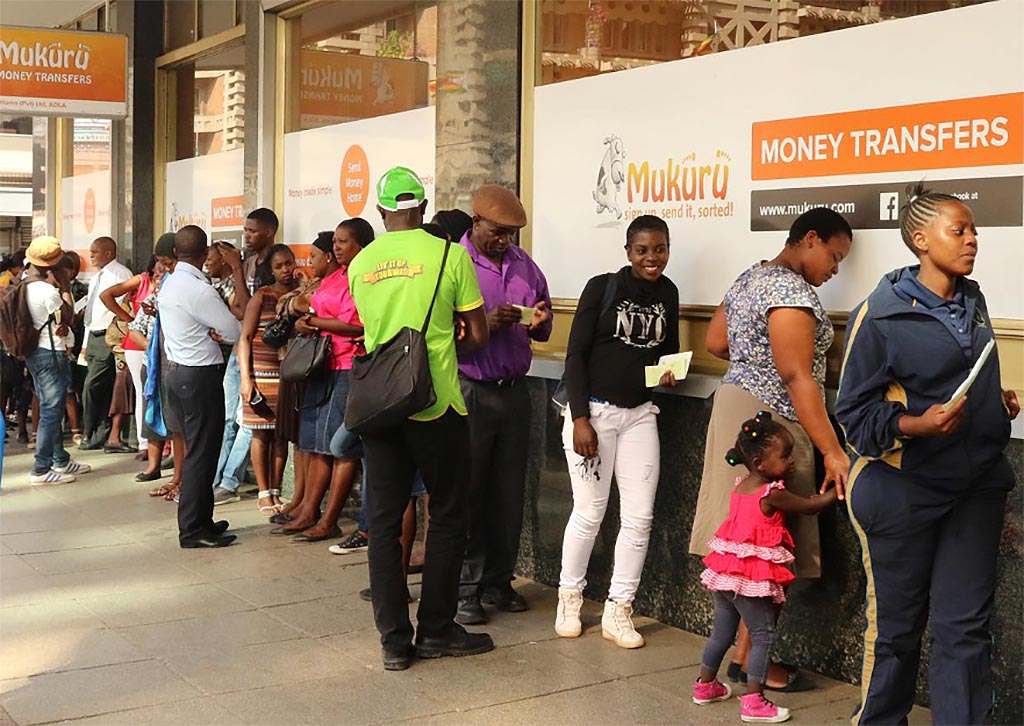
South Africa, the continent’s most industrialised country, has a huge migrant population. Some estimate there are over one million Zimbabweans living there, although there are no official figures.
Ramaphosa was candid about the economic backdrop, conceding that “South Africa faces persistently high levels of unemployment, especially among young people.”
“Too many families are struggling to make ends meet. Too many communities are experiencing poverty and inadequate access to opportunities,” he said.
But he was careful to draw a distinction: “We must recognise that illegal immigration is not the cause of all our economic challenges. The answer must be faster economic growth, greater investment, industrial expansion, infrastructure development and the creation of millions of new jobs.”
Ramaphosa laid out the basic principle underpinning his government’s position.
“Every person within the borders of South Africa should be here legally. Every person who works in our country must be legally permitted to work. Every person who runs a business here must be legally permitted to run a business,” he said.
He acknowledged past failures by the state frankly, admitting “weaknesses in the way migration has been managed.”
“There have been weaknesses in rigorous and focused enforcement. There have been instances of corruption. There have been gaps in our systems that have undermined public confidence. South Africans are entitled to expect better,” he said, adding that his government accepted that responsibility and was “taking decisive action to correct these shortcomings.”
In his most pointed message to anti-immigrant groups, whose June 30 ultimatum has already contributed to violence that left five Mozambican nationals dead in the Western Cape last weekend, Ramaphosa was unequivocal that enforcement was exclusively the state’s domain.
“I must make it clear that only the authorised government officials may act against violations of the law, including violation of our immigration laws. No other person is allowed, for example, to confront someone in the street to demand proof of nationality,” he said.
He warned that his government would move against those exploiting the crisis for other ends.
“We will act against forces who are exploiting the concerns of our people about illegal immigration to further their own political, personal or criminal agendas. We will not be fooled or influenced by social media campaigns that spread misinformation, fake news and lies about foreign nationals,” he said.
He raised alarm over tribal attacks on other South Africans, highlighted by the recent murder of a Tsonga teenager because he spoke limited Zulu.
He cautioned: “We must be concerned that anti-foreigner sentiment is at times accompanied by tribal and ethnic slurs, insults or attacks aimed at other South Africans.”
Illegal migration, if unchecked, “poses a risk to South Africa’s security, stability and economic progress,” Ramaphosa warned, adding that it affects service delivery and places additional burdens on essential services such as health care and education.
“Criminal syndicates involved in trafficking, extortion, illegal mining, drugs and money laundering often use undocumented migration for recruitment and concealment of goods,” he said.
He reserved particular condemnation for employers who exploited undocumented workers.
“There are businesses in our country that employ undocumented immigrants because their legal status means that they cannot stand up for their rights. Some employers hire undocumented immigrants because they pay them wages that are well below the minimum wage and make them work longer hours without due compensation,” he said. “Such conduct will attract far stronger penalties and far stricter enforcement.”
Ramaphosa announced that Cabinet had adopted a Comprehensive Approach for Migration Management, endorsed by the President’s Coordinating Council – a body that includes premiers, MECs and local government representatives.
The crackdown would be led by the Department of Home Affairs, the Border Management Authority and the South African Police Service, who would “intensify the process of identifying and deporting undocumented foreign nationals residing illegally in South Africa.”
The scale of the existing effort was significant, he noted.
“In the past year alone, the Border Management Authority managed to intercept and stop over 450,000 people who were attempting to enter South Africa illegally,” he revealed.
Dedicated immigration courts would be established “to speedily support the deportation of undocumented migrants,” he said, while the Department of Employment and Labour was ramping up its enforcement capacity through “the phased recruitment of 10,000 inspectors for this financial year.”
Employers who continued to violate the Immigration Act faced not just fines but imprisonment.
“We cannot have a situation where employers who, after being charged and found guilty of violating our laws, merely pay a fine and continue employing undocumented foreign nationals whom they exploit,” Ramaphosa said.
On securing South Africa’s porous borders, Ramaphosa framed the matter as a question of basic sovereignty.
“Every sovereign nation has a responsibility to know who enters its territory, why they are entering and how long they are permitted to stay. Secure borders are not a sign of hostility towards other countries. They are a fundamental requirement of a sovereign and well-governed state,” he said.
He announced the phased relocation of refugee reception centres to border posts, starting with the Tshwane centre this year, arguing that processing asylum applications closer to points of entry would make the system “more efficient, more secure and more fair” and ensure “that those who genuinely require protection receive assistance as quickly as possible.”
A significant technological shift was also announced. Ramaphosa said his government was establishing “an Intelligent Population Register that contains biometric data for every person in the country, laying the foundation for a Digital ID,” while simultaneously moving to phase out South Africa’s green identity books, which he said “have enabled identity theft by undocumented immigrants and criminal syndicates.”
The Department of Home Affairs would set a date after which the green ID books would no longer be recognised. He also moved to close a separate loophole involving the Traffic Registration Number, which foreign nationals had been using as a de facto form of identification. The Department of Transport would issue corrective regulations within three months.
On legislation, the Employment Services Amendment Bill had been approved by Cabinet and would empower the minister “to set quotas in respect of the employment of foreign nationals in any economic sector or occupational category.”
Ramaphosa contextualised the crisis as one that ultimately required continental solutions, not just domestic enforcement.
“South Africa cannot address migration challenges alone. Migration is a continental and global phenomenon,” he said.
“Migration pressures cannot be addressed through enforcement measures alone. They require peace where there is conflict, economic growth where there is stagnation and opportunity where there is poverty.”
He announced that he would be dispatching envoys “to a number of sister African countries” to outline the measures announced on Sunday evening.
Ramaphosa appealed for national unity and constitutional values, drawing a deliberate line between the state’s right to enforce its immigration laws and the obligation to uphold human dignity.
“We can protect our borders while protecting human dignity. We can enforce our laws while upholding our Constitution. We can secure our communities while preserving the values of Ubuntu that define us as a people,” he said.
“Let us do so not through fear, anger, hatred or violence, but through unity, determination and respect for the rule of law. Let us build a South Africa that is secure, lawful, compassionate and prosperous — a South Africa in which we expand opportunity, protect people’s dignity and fulfil the promise of democracy for all.”