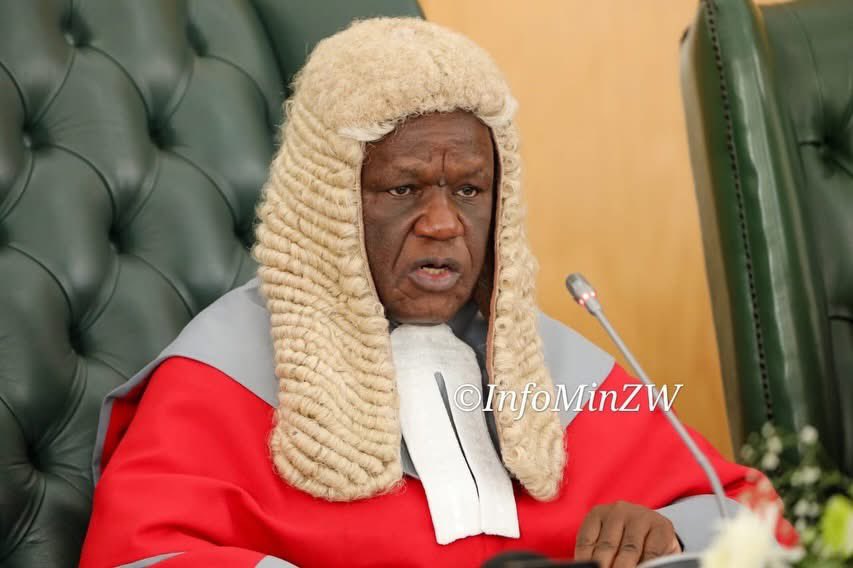
THE hullabaloo accompanying the retirement of erstwhile Chief Justice of Zimbabwe, Luke Malaba, has come and gone. The gushing and over-effusive praises remain a subject of intense discussion within the legal profession and, although a few lawyers were prepared to publicly disagree, in private there are hardly any who share the exaggerated accolades heaped on the retired Chief Justice.
So, what imprint did Luke Malaba leave on Zimbabwe’s judicial system as Chief Justice? Were the accolades deserved, or were speakers engaging in Zimbabwe’s now familiar culture of praise-singing in public and backstabbing in private, as seen in the Robert Mugabe era?
There can be no doubt that Luke Malaba is an above-average jurist. One only has to read his judgments before he became Chief Justice to confirm this. His dissenting opinion in Mawarire v Mugabe N.O. & Others 2012 (1) ZLR 469 (CC) stands as clear evidence of his skill as a jurist of note. In that opinion, he famously refused “to have wool cast over the inner eye” of his mind and proceeded to write a cogent and convincing dissent on what was as clear a political ploy as CAB3. His position was that he would have dismissed the application on the merits.
This was not an isolated instance. He penned many other significant judgments during his tenure in both the High Court and the Supreme Court. It was on the basis of these demonstrated jurisprudential credentials that, when there appeared to be reluctance to appoint him Chief Justice despite being the best candidate at interviews, some of us approached the courts to question the relevance of the process if the best candidate could be overlooked.
When he was ultimately appointed, there were great expectations of a new judicial era—one in which citizens would enjoy the rights and freedoms overwhelmingly approved in the March 2013 constitutional referendum. Regrettably, the retired Chief Justice dismally failed to discharge his duties with the independence, fairness and impartiality envisaged by the Constitution. Instead, he embarked on what can only be described as a journey of “yekufadza mutengi wedoro,” where justice was perceived as any outcome that favoured the executive.
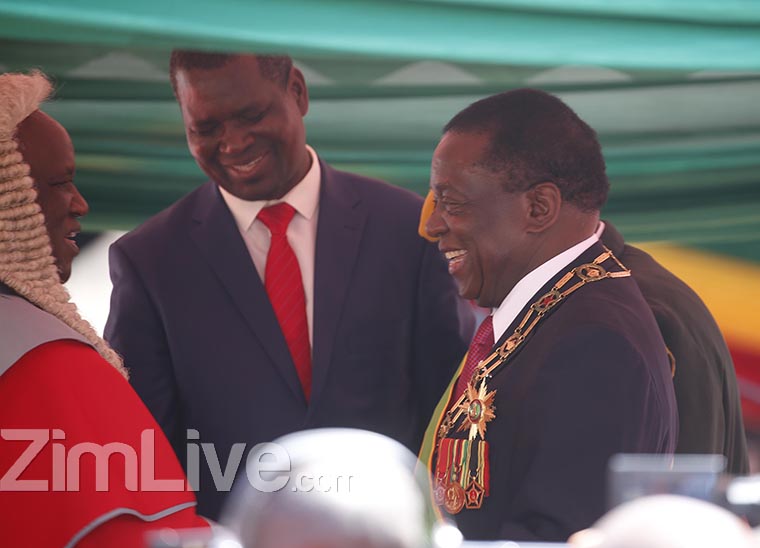
I followed, with disbelief, as speaker after speaker at his retirement praised his perceived leadership in glowing terms, placing him on a pedestal never reached by his predecessors. It felt like attending a funeral, listening to eulogies where each mourner tries to outdo the other in praise, in keeping with the “wafa wanaka” philosophy.
Retired Chief Justice Malaba was not a constitutionalist—more by choice than by lack of ability. His dissent in Mawarire demonstrates beyond doubt that he understood constitutionalism and possessed the necessary interpretive skill. He simply chose not to deploy these attributes where doing so would not serve the interests of the appointing authority.
He chose not to side with the people. He chose to disregard the constitutional imperative that courts be independent and impartial, subject only to the Constitution, and that its provisions be applied without fear, favour or prejudice in the protection of human rights, the rule of law and constitutionally guaranteed freedoms.
The retired Chief Justice became an unashamed gatekeeper at the Constitutional Court, permitting only those cases he believed met his threshold to proceed. Even where litigants managed to pass through these tightly controlled gates, technicalities—alien to constitutional jurisprudence—were deployed to avoid determining substantive constitutional issues that could have advanced citizens’ rights.
Instead of expanding access to the Constitutional Court, he introduced control mechanisms previously unknown to his predecessors, including practice directives that curtailed judicial independence. These included requiring judges to submit judgments for “approval,” later softened to “seen,” before delivery.
Despite having enjoyed the freedom to issue dissenting opinions under former Chief Justice Chidyausiku, he denied Supreme Court judges the same latitude by discouraging dissent, fostering a herd mentality that stifled jurisprudential development. This was coupled with what he termed “uniform” judgment writing.
He even sought to have judges attend a workshop at ZANU PF’s Herbert Chitepo School of Ideology, despite constitutional provisions proscribing the advancement of partisan political agendas by judicial officers. A true constitutionalist leaves behind a body of work demonstrating fidelity to constitutional principles and enabling citizens to enjoy their rights.
Where the executive overreaches—as it often does—a constitutionalist ensures that state power is clearly defined, limited, and anchored in the Constitution as the supreme law. Regrettably, this was not evident under Chief Justice Malaba. Instead, citizens’ rights were eroded in ways previously unimaginable.
Where the Constitution and the Criminal Procedure and Evidence Act envisage bail as a right, its grant became, in certain cases, a near impossibility. This fostered unchecked abuse of power, where individuals without reasonable suspicion of wrongdoing were routinely arrested and denied bail, while blatant criminality in other contexts went unaddressed.
Litigation during his tenure increasingly felt less like a search for justice and more like an exercise in record-keeping, with outcomes in certain categories of cases becoming predictable. Constitutionalism was effectively absent, replaced by a form of absolutism aligned with the interests of the appointing authority.
Where necessary, he did not hesitate to sit in matters in which he had a direct interest, in violation of the foundational principle that no one should be a judge in their own cause.
This disregard for constitutional norms extended beyond litigants to the judiciary itself. Judges and judicial officers, constitutionally required to act independently and impartially, operated under sustained pressure during his tenure. Public interviews for judicial appointments became hostile, deterring many qualified candidates from applying.
Those who persevered and performed well were not always appointed, as executive preferences appeared to prevail. This undermined the constitutional requirement for an independent judiciary, as those appointed under such conditions may be susceptible to undue influence.
As head of the judiciary and chairperson of the Judicial Service Commission (JSC), Chief Justice Malaba presided over a body that, despite its constitutional design as a broad-based institution, functioned in practice as a personal fiefdom. Apart from the chairperson of the Civil Service Commission, few members demonstrated independence.
The JSC remained largely silent in the face of clear procedural irregularities and constitutional breaches. Its mandate to promote judicial independence, accountability and transparency was effectively abandoned. There was little response when tribunal recommendations were delayed, when judges’ independence was curtailed through directives, or when controversial decisions—such as attendance at the Herbert Chitepo School—were made.
A commission intended as a system of checks and balances became, in effect, a one-man institution. It is hoped that new leadership will restore its intended function.
It is correct that retired Chief Justice Malaba oversaw an impressive decentralisation programme, bringing courts closer to communities that previously faced significant barriers to access. It is also true that he introduced the Integrated Electronic Case Management System, which, when functional, improves efficiency for users able to navigate it.
These are commendable developments upon which the new Chief Justice can build. However, infrastructure alone is not justice. Citizens would prefer fair, impartial and independent justice under a tree to unjust outcomes delivered in modern courtrooms with advanced technology.
It is therefore unfortunate that speakers at his retirement chose praise-singing over truth-telling. Such conduct risks encouraging future judicial leaders to follow a similar path, confident that their records will be sanitised at the end of their tenure.
As an active litigant, I welcome Luke Malaba’s retirement—an event that, if he were truly a constitutionalist, should have occurred five years earlier.
Beatrice Mtetwa is a prominent lawyer and human rights advocate