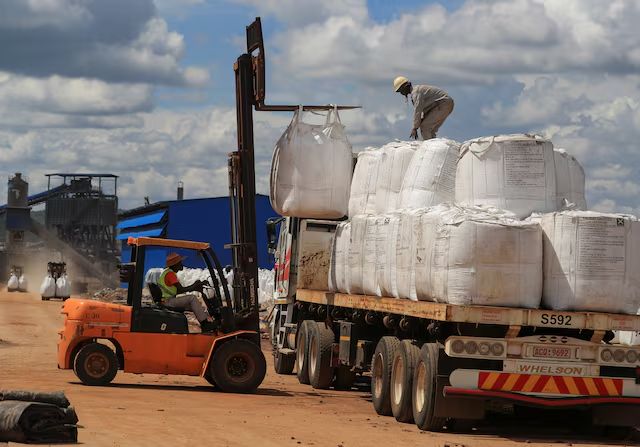
VICTORIA FALLS – Lithium miners in Zimbabwe have asked the government for more time to build processing facilities, ahead of a January 2027 ban on concentrate exports, an industry executive said on Thursday.
Zimbabwe, Africa’s top lithium producer, has been pressing miners operating in the country to process more of the battery metal locally as it seeks to extract more economic benefit from the mineral.
It recently introduced lithium concentrate quotas and imposed a 16 percent tax on lithium concentrate exports, after ordering a temporary halt in shipments, citing mineral leakages.
The Zimbabwe’s Lithium Producers’ Association said major lithium miners in the country were at various stages of building lithium sulphate plants, with only one, owned by China’s Zhejiang Huayou Cobalt completed and exporting chemicals.
Sinomine’s Bikita Minerals and Sichuan Yahua’s Kamativi lithium mines were building lithium sulphate plants, while the state-owned Sandawana mine was conducting a processing feasibility study, association chairman Innocent Rukweza told a mining conference in Victoria Falls.
“It is a strong appeal that we are presenting to our regulators, that we finalise the work that is going on and extend the beneficiation ban maybe to June next year,” Rukweza, CEO of state-owned lithium miner Mutapa Energy Resources, said.
“We plead that we be given just a little bit of leeway, because the deadline might be a bit tight,” he added.
The mines ministry did not immediately respond to requests for comment.
Lithium producers are grappling with high taxes and costs, as well as policy shocks such as February’s export ban, but Rukweza said the industry forecasts 344,000 metric tons of annual lithium sulphate output by 2030.
Chinese firms, which have invested about $2 billion since 2021, dominate Zimbabwe’s lithium mining sector, consolidating the Asian giant’s grip on the global battery metal supply chain.
Zimbabwe exported 1.13 million tons of lithium-bearing spodumene concentrate to China in 2025, accounting for about 15 percent of its lithium concentrate imports for the year. – Reuters