PRETORIA – South Africa’s department of international relations and cooperation has hit back at United States ambassador Leo Brent Bozell III after he publicly accused Pretoria of abandoning its claimed foreign policy of non-alignment, pointing to Pretoria’s simultaneous hosting of Iran’s deputy foreign minister and deputy president Paul Mashatile’s visit to China as evidence the country had “chosen” sides against Washington.
In a post on X on Wednesday under the hashtag #NotSoNonAligned, Bozell wrote that “the government of South Africa rolls out the red carpet for Iran’s deputy foreign minister, while deputy president Mashatile is in Beijing deepening ties with China.”
He said Pretoria’s description of this as non-alignment was, in his words, “a choice,” adding that “the South African people deserve an honest conversation about who their government is choosing to stand with.”
The remarks come just months after Bozell was issued a formal démarche by South Africa’s department of international relations and cooperation, and weeks after President Cyril Ramaphosa publicly warned foreign envoys against criticising their host government in public.
Bozell, a conservative writer and activist nominated by United States President Donald Trump in March 2025, has had a turbulent tenure in Pretoria almost from the outset.
Less than a month after arriving in the country, he told a business conference in Hermanus that he “didn’t care” what South African courts had ruled on the liberation-era chant “Kill the Boer, kill the farmer,” insisting it amounted to hate speech despite the Constitutional Court having found otherwise.
DIRCO summoned him over the remarks, with director-general Zane Dangor confirming Bozell “expressed his regrets that these comments detracted from any impression that he wanted to work with us constructively,” after which the US mission issued a public apology.
A parliamentary portfolio committee separately rejected Bozell’s description of black economic empowerment and land reform policies as “apartheid-like,” with committee chairperson Xola Nqola saying that publicly dismissing rulings of the Constitutional Court and Supreme Court of Appeal breached diplomatic protocol and amounted to “an affront to the sovereignty of the South African state.” The Economic Freedom Fighters called at the time for Bozell to be declared persona non grata and expelled.
Bozell went on to formally present his credentials to Ramaphosa on April 8. At that ceremony, Ramaphosa is reported to have issued a veiled warning to the assembled diplomats that they should rely on “quiet, constructive diplomacy” and should “never criticise their host countries publicly and in a confrontational manner.”
Wednesday’s posts appears to test that warning directly.
The ambassador has previously laid out a list of US demands of Pretoria, including that South Africa reconsider its Expropriation Act and BBBEE policies, condemn the “Kill the Boer” chant, prioritise farm murders, withdraw its genocide case against Israel at the International Court of Justice, and adopt a genuinely non-aligned foreign policy distancing itself from Iran, Russia and China. Bozell has said Washington is “running out of patience” with South Africa’s failure to respond to those demands.
China’s ambassador to South Africa, Wu Peng, responded to Bozell’s post.
“Out of respect and diplomatic protocol, we don’t make comments on South Africa’s relations with other countries,” Wu said. “Likewise, we oppose envoys of other countries publicly commenting on relations between China and South Africa.”

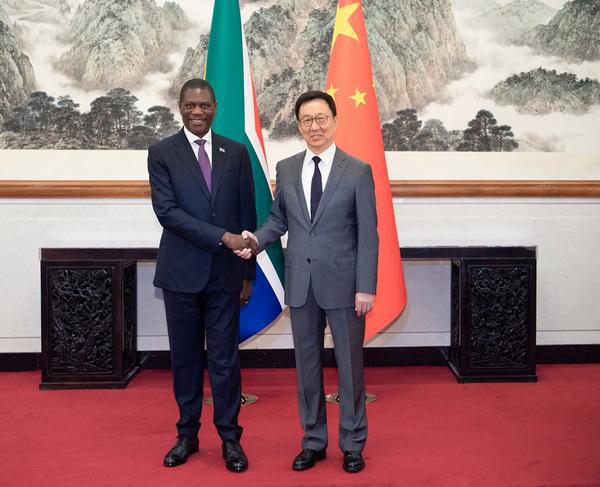
South Africa’s presidency, for its part, confirmed that Mashatile held bilateral talks in Beijing with Chinese vice president Han Zheng, describing the meeting as reaffirming “the strong political trust and historic solidarity that continue to underpin South Africa-China relations” within what it called the two countries’ “All-Round Strategic Cooperative Partnership in the New Era.”
The statement said the meeting followed the ninth South Africa-China Bi-National Commission, hosted in Cape Town in March.
Mashatile separately addressed the China International Supply Chain Expo this week, reaffirming South Africa’s commitment to the partnership and signalling a shift towards value-added exports and infrastructure cooperation with Beijing.
Iran’s deputy foreign minister, Saeed Khatibzadeh, was in Pretoria the same week, though it was not immediately clear what was discussed. The visit comes weeks after the end of a US-Israeli war with Iran, fought between February and June this year, which has left China positioning itself as a continuing strategic partner to Tehran even as Washington and Iran signed a memorandum of understanding on a first stage of negotiations.
DIRCO issued a media statement on Thursday responding directly to Bozell. The department said it had noted “the recent public statement attributed to the United States Ambassador,” and while South Africa “does not engage in public disputes with resident envoys,” the remarks “necessitate a clear reaffirmation of our guiding principles.”
“As a sovereign nation, South Africa pursues an independent foreign policy firmly anchored in the principle of non-alignment,” the statement read. “Non-alignment must not be conflated with neutrality, we refuse to be drawn into geopolitical contestations or be pressured to take sides; instead, we prioritise inclusive dialogue, global peace, and our own national interests. Accordingly, we reserve the right to cultivate bilateral relations across the global spectrum.”
DIRCO pointedly turned the criticism back on Washington, saying it noted “the inherent contradiction in being publicly scrutinised for engaging Iran and China, the very same states with which the United States itself continues to actively interact.”
The department said South Africa remained “committed to utilising established diplomatic channels to engage the United States,” and trusted “that such protocols will be mutually upheld moving forward” – a line that reads as a pointed reminder to Bozell about the public criticism he has now levelled at Pretoria on two separate occasions.
South Africa’s international relations minister, Ronald Lamola, has consistently defended Pretoria’s posture as principled rather than anti-Western.
“On foreign policy, South Africa does not take sides with any one country,” Lamola has said, describing non-alignment as the country’s “ability to engage all international partners and take positions on a case-by-case basis, guided by our human rights outlook and international law.”
Washington has remained unconvinced. Relations between the two countries have deteriorated sharply since Trump returned to office, marked by the expulsion of South Africa’s former ambassador to Washington, Ebrahim Rasool, the suspension of US aid, tariffs on South African exports, and Trump’s repeated and widely disputed claims of a genocide against white farmers.
South Africa has not had an ambassador in Washington since Rasool’s expulsion in March 2025, though Roelf Meyer has now been deployed in an effort to stabilise the relationship.