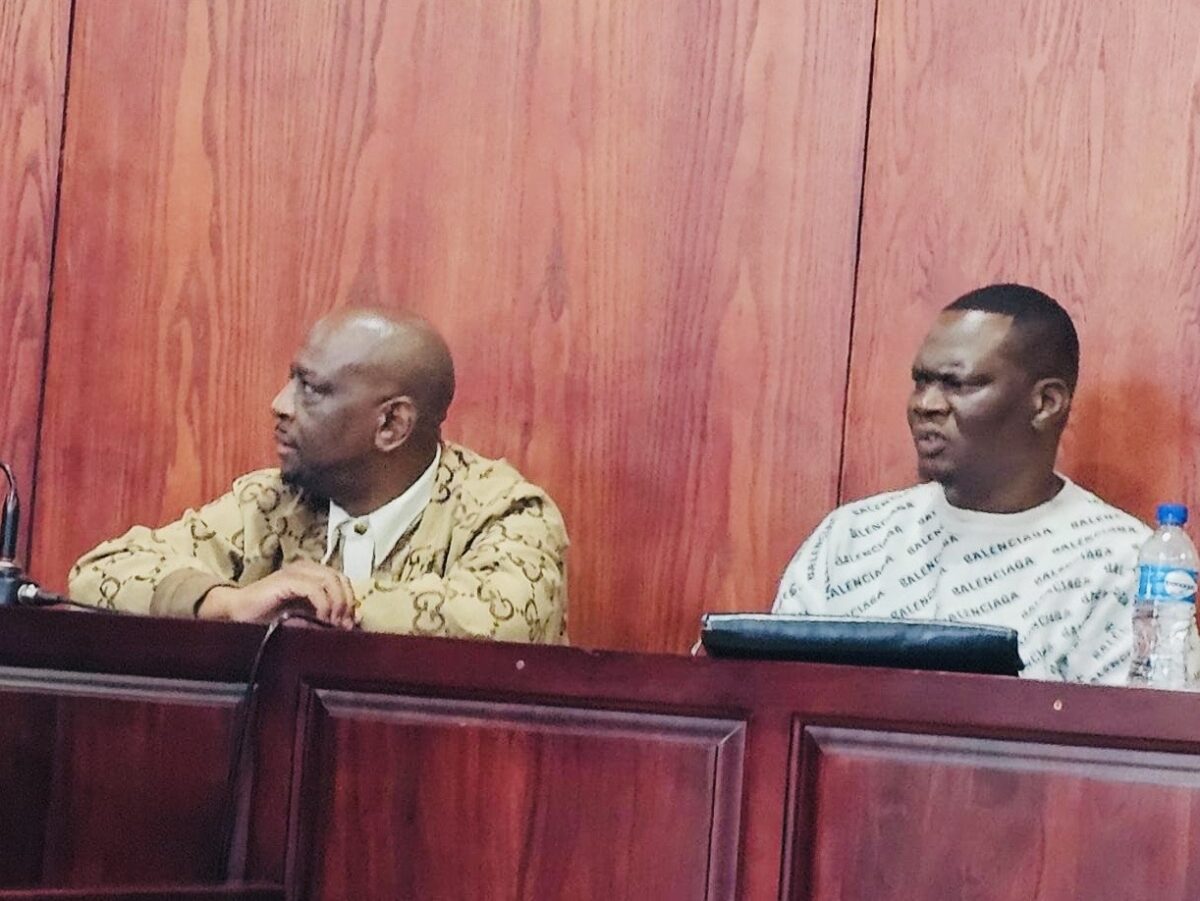
HARARE – The Supreme Court has thrown out the bulk of the grounds on which Moses Mpofu and Mike Chimombe sought to challenge their convictions and sentences over a Presidential Goat Pass-on Scheme fraud, though both men were allowed to proceed on narrow points of law without needing leave.
In a judgement handed down on August 4, Justice George Chiweshe, sitting in chambers with Justices Susan Mavangira and Hlekani Mwayera concurring, dismissed applications for leave to appeal filed by Mpofu and Chimombe, after finding their grounds attacking the trial court’s factual findings had no prospects of success.
Mpofu and Chimombe were convicted by the High Court of fraud arising from a tender for the government’s Presidential Goat Pass-on Scheme, a 2021 initiative by the Ministry of Lands, Agriculture, Water, Fisheries and Rural Development aimed at distributing 500,000 goats to poor households nationwide.
The court a quo had found that the pair used forged ZIMRA tax clearance and NSSA compliance certificates belonging to another company, Skywalk Investments, to win the tender in the name of Blackdeck Livestock and Poultry Farming (Pvt) Ltd — an entity the State proved did not legally exist. The genuine registered company, Blackdeck (Pvt) Ltd, had already been deregistered from the NSSA system in 2016.
On the strength of those misrepresentations, the Ministry paid a 30% advance of ZWL$1.6 billion into Blackdeck’s bank account, from which substantial sums were allegedly diverted to Millytake Enterprises (Pvt) Ltd, a company linked to one of the applicants. Only 4,208 of the contracted 632,001 goats, worth USD331,445.25, were ever delivered before the Ministry cancelled the contract in August 2022, leaving actual prejudice to the fiscus of USD7.38 million.
Mpofu was sentenced to an effective 15 years’ imprisonment plus restitution of USD2,060,250.60, while Chimombe received an effective 12 years plus restitution of USD964,064.64.
Both men sought leave to appeal after the High Court refused it. Their lawyers argued the State had not proved they personally authored the fake documents, that the matter was a civil contractual dispute rather than a crime, and that the sentences were shockingly severe.
Justice Chiweshe rejected most of these arguments, finding “there is not an iota of evidence supporting” the claim that the genuine Blackdeck (Pvt) Ltd, rather than the fictitious Blackdeck Livestock and Poultry Farming, had submitted the tender bid. On the question of criminal liability for company directors, the judge held that section 277 of the Criminal Law Code “does not require proof that a director personally forged documents. It is sufficient that, with knowledge, he participated in or authorised conduct constituting the offence.”
On sentence, the judge found no basis to interfere, noting the aggravating factors — the involvement of public funds meant to alleviate poverty, the considerable value of the funds, and their non-recovery — meant the trial court’s approach could not be faulted.
The court did, however, find that a handful of grounds raised by each applicant were points of law alone, which by operation of law do not require leave to appeal under section 44(2)(a) of the Act.
Mpofu was granted liberty to proceed, without leave, on three such grounds against conviction. The first is that the trial court erred in law by treating the charge — which had identified only three acts of misrepresentation, namely the forged ZIMRA certificate, the forged NSSA certificate, and deception over the identity of Blackdeck Livestock and Poultry Farming — as if it also encompassed the consequences and prejudice flowing from those acts as part of the misrepresentation itself. The second is that the court convicted him on what he argues are mutually contradictory findings: that Blackdeck Livestock and Poultry Farming was not a real legal entity, while at the same time holding him criminally liable under section 277 of the Criminal Law Code as a director of Blackdeck (Private) Limited, a company that was properly incorporated. The third is that the court erred in treating the use of a trade name on the tender documents as improper, when the law permits trade names to be used in business and in litigation.
Chimombe was similarly granted liberty to proceed, without leave, on one ground against conviction — that the trial court’s finding that he possessed the requisite mens rea to commit fraud as a co-perpetrator under section 196A(1) of the Criminal Law Code was irrational, in that no reasonable court, properly applying its mind to the totality of the evidence, could have reached that conclusion.
All other grounds raised by both men — covering the remaining conviction challenges and the entirety of both sentence appeals — were found to raise questions of fact or mixed fact and law requiring leave, which was refused. No order was made as to costs, given the criminal nature of the proceedings.
Mpofu was represented by Tafadzwa Mapuranga with Tapson Dzvetero, and Chimombe by Lovemore Madhuku with Ashiel Mugiya. The National Prosecuting Authority, represented by Whisper Mabhaudhi, appeared for the State in both matters.