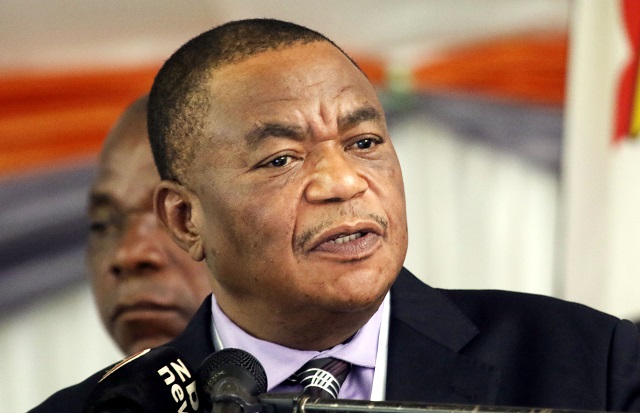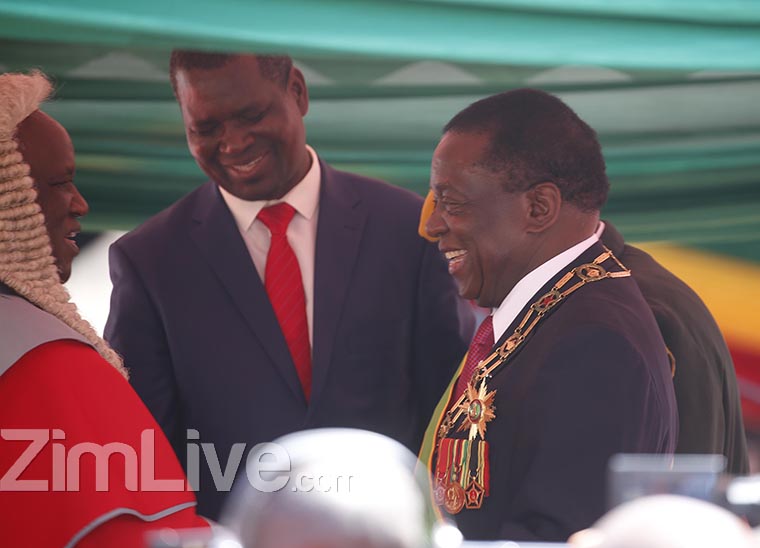
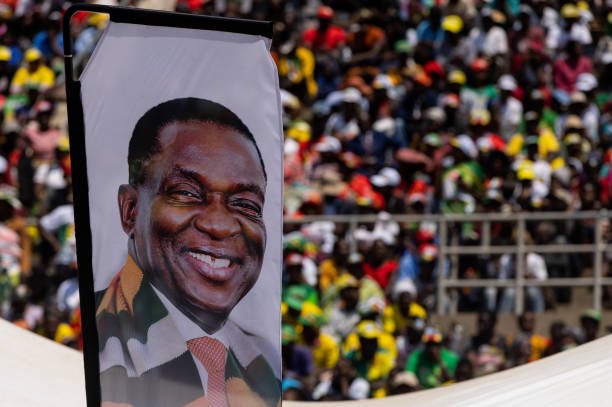
HARARE – President Emmerson Mnangagwa has given himself a birthday present: a new public holiday named after one of Africa’s great pre-colonial empires.
September 15, the president’s birthday, will henceforth be known as Munhumutapa Day, according to a special government gazette issued on Wednesday.
Mnangagwa, who turns 84 this year, has thus far stopped short of claiming the throne of the Munhumutapa empire, the Shona kingdom whose influence once stretched across much of present-day Zimbabwe and Mozambique before its decline in the 18th century.
But the timing of the declaration has prompted speculation that the president’s ambitions may extend beyond the constitutional order he has already altered to prolong his stay in office.
The announcement came on the same day Mnangagwa told the Sanganai/Hlanganani World Tourism Expo in Masvingo that he expected still to be in charge nine years from now – a reference to his increasingly explicit ambition to remain president beyond 2030.
“In nine years, after rotating provinces to host this event, I will still be in power,” he said in an unscripted remark.
Advocate Thabani Mpofu, a constitutional law expert, said the coincidence should not be easily dismissed.
“In my view, the Munhumutapa declaration is significant. It sits somewhere between CAB3 and CAB4, and the fact that Mnangagwa issued it on the same day he announced plans to remain in power beyond 2030 should give us serious pause,” Mpofu said, referring to Constitution of Zimbabwe Amendment Bill No.3, which Mnangagwa signed into law in July.
“I choose to see it, insane as it may sound, as the beginning of an attempt to alter our constitutional order; perhaps the first step towards a monarchy,” he said.
“This is not senile madness. It is something far more troubling: a desecration.”
A football tournament, the Munhumutapa Cup, bankrolled to the tune of $5 million by the president’s wealthy associates including gold dealer Scott Sakupwanya was launched early this year.
The late Mugabe celebrated his birthday every year surrounded by children in what was known as the 21st February Movement. It was only after his death in 2019 that February 21 was declared a holiday, known as National Youth Day.
The Munhumutapa empire, also known as Mutapa, emerged in the 15th century and became a powerful trading state, controlling gold-producing territory and trading with merchants from the Indian Ocean coast.
Its name has long carried political and cultural resonance in Zimbabwe. Turning the president’s birthday into Munhumutapa Day, however, represents a striking new use of that historical legacy.
Mnangagwa came to power in November 2017 after the military coup that ended Mugabe’s 37-year rule. He promised a break with the past and a new era of democratic reform.
Instead, his critics accuse him of becoming increasingly intolerant of dissent while using controversial constitutional changes to consolidate power.
Constitutional Amendment No.3 extended the terms of the president and parliament from five to seven years, moving the next elections from 2028 to 2030. Mnangagwa is constitutionally barred from seeking a third term under the existing arrangement, although Zanu PF has increasingly debated ways of keeping him in office beyond 2030.
Now his birthday has acquired an imperial name.