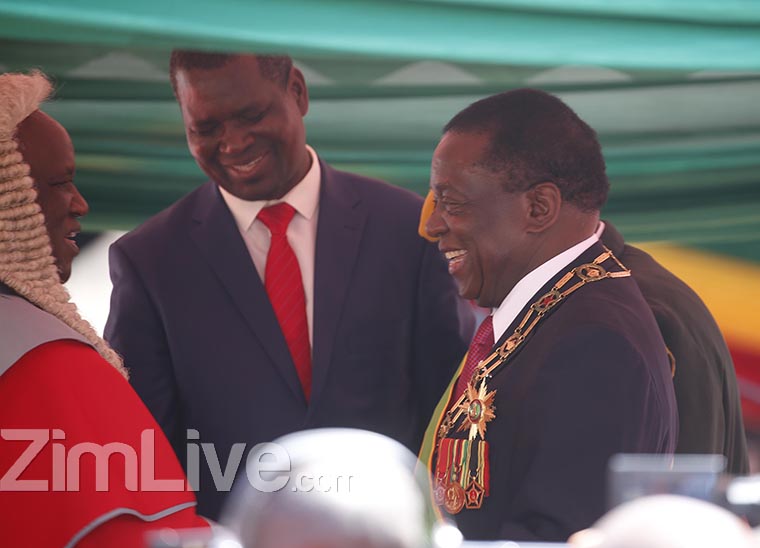
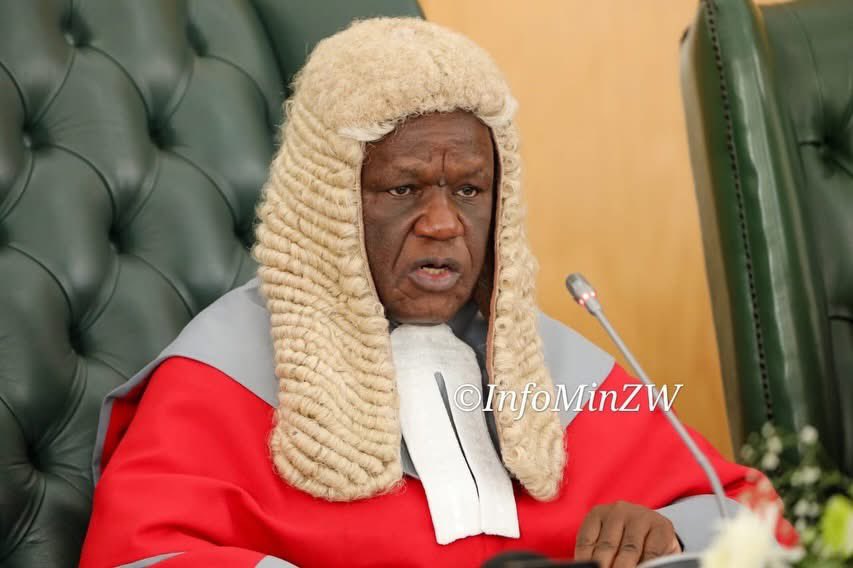
Transcript of Chief Justice Luke Malaba’s retirement speech during a special sitting of the Constitutional Court in Harare on May 14, 2026
It is an honour to deliver this valedictory speech on the occasion of bidding farewell to the Bench. At the outset, deep appreciation is extended to all the speakers who have spoken in tribute on this occasion. Each tribute, in its own measure, has added meaning to this farewell and is received with the deepest gratitude.
The generous tributes signal the fact that at midnight today the bell of the Constitution will toll for the end of a long period of judicial service. The tributes signal that the exit will be with dignity.
The occasion is, in many respects, a rare judicial sitting to take place in the jurisdiction. It is not an ordinary sitting of a court. It is a sitting convened for the special purpose to mark the conclusion of a judicial career. Needless to say, the judicial career is one in which I have had the honour to serve. I feel deeply honoured and humbled to be experiencing this momentous occasion.
Nothing, in the context, can be as comforting and satisfying as the realisation that one has served the people right up to the highest office of judicial leadership with the necessary diligence, competence and faith in the ideals of justice.
In delivering the valedictory speech, a brief reflection on the office of a judge and the judicial career is merited. The office of a judge is a public office. It is an office held in trust for the people. It demands fidelity to the Constitution, loyalty to the law, independence of mind, humility of service and an unwavering commitment to justice. It is not an office that belongs to the individual who occupies it. It belongs to the constitutional order and to the people in whose name judicial authority is exercised.
Reflection on the office of a judge would be incomplete without reference to the judicial oath. The judicial oath, set out in the Third Schedule to the Constitution of Zimbabwe, is the constitutional act binding every individual who steps into judicial office for the duration of his or her tenure to the principles that define that office. It is not a ceremonial act, but a creed of justice. It is the internal instrument through which the rule of law is made operative in the daily life of the Judge. Its obligations are continuous; they do not cease when the courtroom adjourns.
Looking back over the years, the oath taken many decades ago has been the most constant companion on my judicial journey. Every appointment served, from the High Court to the Supreme Court and ultimately to the office of Chief Justice, has been an occasion to take that oath afresh and to renew the commitment it embodies. The oath has demanded a continuing self-redefinition, a movement away from selfishness, self-interest and self-centredness towards service of the people.
If there is one message that may be drawn from the judicial career and offered to those who remain in service, it is to keep the oath. The judicial career, properly understood, is nothing more and nothing less than a lifelong commitment to the oath that was taken on the first day assumption of the judicial office.
The taking of the judicial oath is a deeply personal and solemn promise to uphold and protect at all times the fundamental values of constitutionalism, the rule of law, judicial independence, justice, impartiality, fairness and integrity in the discharge of the judicial function.
Given that judicial office is held in trust for the people, the end of judicial service is not a private moment of departure. It is an institutional moment that must be marked in the presence of the court, the profession and the public whose mandate the judge has discharged. The occasion of the special court sitting is, thus, in its proper sense, a valedictory occasion. It is an occasion that celebrates the values expressed through judgments and the contribution made to the vindication of justice in society.
It must be emphasised that a judicial career is not measured only by the passage of time or by the number of years served on the Bench. It is measured by the quality of service rendered, the fidelity shown to the Constitution and the law, the discipline brought to the judicial function and the extent to which the work of the court has strengthened society’s confidence in institutions mandated to deliver justice.
The sense of justice in a community is shared. It is built over time through the work of institutions, the conduct of public officers and the decisions of courts. Every judgment delivered by a court contributes, in one way or another, to that shared understanding. It explains rights and duties. It resolves disputes. It vindicates lawful claims. It restrains unlawful conduct. It gives practical meaning to the promises of the Constitution and the laws of the country. Jurisprudence, like all other measures of the reforms of the justice delivery system, must strengthen the judicial institution.
For that reason, this occasion is not merely a farewell . It is a moment of institutional reflection on the work done, the values served, the principles defended and the contribution made to the administration of justice. It is also a moment of gratitude. It calls for acknowledgment of the privilege of service and the recognition that the work of judging forms part of a larger constitutional project, namely, the pursuit of justice under law.
Accordingly, in giving this vote of thanks, an observation must be made at the outset. The opportunity to express gratitude on an occasion such as this has invited deep reflection. A judicial career, particularly one that carries the responsibilities of the office of Chief Justice, is never sustained by the efforts of one person alone. It is sustained by the work, sacrifice, counsel, loyalty and support of many people and institutions.
While it is not possible to name every person who has contributed to this journey, it must, however, be stated at once that there is no hierarchy in the expression of gratitude. Each person and each institution to be acknowledged has contributed in a distinct and meaningful way to the work of justice, the strengthening of the courts and the service rendered to the people.
It must be said that the generous tributes recognise and celebrate the collective and relentless commitment and strategic effort in pursuit of a reform vision that transformed the justice delivery system.
Gratitude must first be expressed to the people of Zimbabwe. Judicial authority is derived from the people. It is exercised in their name, on their behalf and for their benefit. The people are the ultimate beneficiaries of the work of the courts. They entrust judges with the solemn duty of resolving disputes, protecting rights, upholding the Constitution and ensuring that justice is administered without fear or favour. To have served in an office that draws its authority from the people is a great honour. The justice delivery system depends on the trust and the confidence reposed in its institutions by the people.
Gratitude is also due to the judges and judicial officers, both past and present, with whom this journey has been shared. The life of a judge is, in many respects, a lonely life. It is lived in the quiet discipline of reflection, research, decision-making and the writing of judgments. Yet it is also a life sustained by colleagues on the Bench. The opportunity to work with judicial officers, to exchange ideas, to debate questions of law, to learn from one another, to belong to a shared institution and to form lasting professional bonds has been a privilege of immeasurable value.
The legal profession also deserves special acknowledgment. Judges do not develop the law in isolation. The law is shaped through the arguments presented by legal practitioners, the diligence with which they prepare cases, the honesty with which they assist the court, and the respect they show for the administration of justice. The Bench and the legal profession are different arms of the same system of justice. Each depends on the other for the law to remain principled, practical and responsive to the needs of society. Both must be honest agents of the law.
Gratitude is also extended to the other stakeholders in the justice, law and order sector for the different roles played in supporting the administration of justice. These include the Attorney-General’s Office, the National Prosecuting Authority, the Legal Aid Directorate, the Ministry of Justice, Legal and Parliamentary Affairs, the Zimbabwe Republic Police and the Zimbabwe Prisons and Correctional Services among others. The delivery of justice requires the cooperation and collaboration of many institutions. Courts cannot function effectively in isolation from the broader justice system. The contribution of each institution within that sector has been important to the work of ensuring that justice remains accessible, credible and effective. Although the values are shared, they are pursued from independent constitutionally defined roles that must be respected.
The Government of Zimbabwe must also be acknowledged, particularly for the support rendered to the Judiciary during my tenure as Chief Justice. That support made it possible for significant transformation to take place in the justice sector. The Judiciary witnessed major progress in digitisation, court construction, judicial training, decentralisation of court services and the strengthening of institutional capacity. These developments required financial and administrative support. They stand as part of the institutional legacy of a Judiciary that has sought to modernise, expand access to justice and respond to the needs of the people.
Special gratitude must be expressed to the Judicial Service Commission, the Secretary of the Judicial Service Commission, Dr W T Chikwana, and the staff of the Judicial Service Commission. The work of the Judicial Service Commission is often carried out away from public view, yet it is central to the functioning of the Judiciary. There are many battles fought, many hardships endured and sacrifices made for the benefit of the courts and the people they serve. The dedication, loyalty and resilience of the Judicial Service Commission and its staff have supported the work of the Judiciary in ways that deserve sincere acknowledgment.
Gratitude must also be expressed to my wife, Eunice, and to my children, Mhanisi, Chatapiwa and Takula. Their love, patience, understanding and support have been a constant source of strength through the highs and lows of judicial service. On many occasions, their presence and encouragement made it worthwhile to continue pursuing the cause of justice for the benefit of all. I thank you.
As this judicial journey draws to a close, parting words must be directed, first, to the Judiciary. The Judiciary is an institution of immense constitutional significance. Its strength lies in its independence, integrity, discipline and fidelity to the law. Judges and judicial officers must continue to guard these values with courage and humility. The authority of the court does not rest on force. It rests on public confidence, reasoned decision-making, impartiality and the visible commitment of every judicial officer to do justice according to law.
To the judges and the judicial officers who remain in service, the call is to continue the work with diligence and conviction. The burden of justice is heavy, but it is also honourable. Every matter that comes before a court carries the hopes, fears, rights and obligations of real people. The manner in which those matters are heard and determined shapes the public’s understanding of justice. The Judiciary must therefore continue to be accessible, efficient, independent and faithful to the Constitution.
To the Judicial Service Commission and the staff who support the courts, the message is one of encouragement. The administration of justice depends not only on judgments delivered in courtrooms, but also on the unseen work that keeps the institution functioning. Files must move. Courtrooms must open. Records must be kept. Litigants must be assisted. Technology must work. Infrastructure must be maintained. Training must continue. These responsibilities may not always attract public attention, but they are central to the life of the Judiciary.
To the legal profession and the justice, law and order sector, the appeal is to continue assisting the courts with integrity. Courts cannot operate effectively without the cooperation of the institutions that form part of the broader justice delivery system. Each institution must continue to play its part with professionalism, respect for the Constitution and an appreciation that the ultimate beneficiary of the system is the public. Equally, the quality of justice is strengthened when legal practitioners approach their duties with seriousness, respect for the court and loyalty to the law. The court relies on the profession to present issues clearly, argue responsibly and uphold the standards of legal practice. In that way, the legal profession remains an indispensable partner in the administration of justice.
To the nation at large, the message is that the Judiciary belongs to the people. Judicial authority is derived from the people and must always be exercised for their benefit. The courts exist to protect rights, resolve disputes, uphold the Constitution and ensure that power is exercised within the limits of the law. Public confidence in the Judiciary is therefore essential. That confidence is strengthened when the courts act independently, when the public respects court processes and when all persons accept that justice under law is a foundation of peace, order and constitutional democracy.
The Judiciary has given far more than can be adequately expressed on an occasion such as this. It has given the privilege of service, the discipline of law, the burden of responsibility and the rare opportunity to participate in the shaping of justice in the life of the nation. It has provided a place from which to observe the hopes, grievances, struggles and aspirations of the people of Zimbabwe as they came before the courts seeking the protection of the law. Sadly, it has also brought to the scales of justice the worst side of mankind through crimes of gratuitous violence such as murders, rapes and robberies,
From the Judiciary, there is taken a deepened conviction that justice is not an abstract ideal. It is a lived reality that must be made visible through the daily work of courts. It is found in the careful hearing of a litigant, the disciplined interpretation of the law, the protection of constitutional rights, the impartial resolution of disputes and the courage to decide according to the law even where the decision may not be popular.
CONCLUSION
As this chapter comes to a close, there is a sense of gratitude rather than regret. The work has been demanding, but it has been honourable. The burdens have been heavy, but they have been carried in service of a noble constitutional mandate. The journey has required sacrifice, patience and perseverance, but it has also brought fulfilment, purpose and a profound appreciation of the role of law in ordering society.
The conclusion of a judicial career does not mark the end of belief in justice. It marks the handing over of a continuing responsibility to those who remain in service. The work of the courts must continue with courage, humility and independence. The Constitution must remain the guiding instrument. The people must remain the reason for the exercise of judicial authority. Justice must remain the object to which every court, every judge and every judicial officer is faithfully committed.
It is in that spirit that this farewell is made. With gratitude for what the Judiciary has given, with humility for the opportunity to have served and with confidence in the future of the institution, this valedictory occasion may properly be perceived as both an ending and a continuation. It is the end of one judicial journey, but not the end of the work of justice.
I THANK YOU!