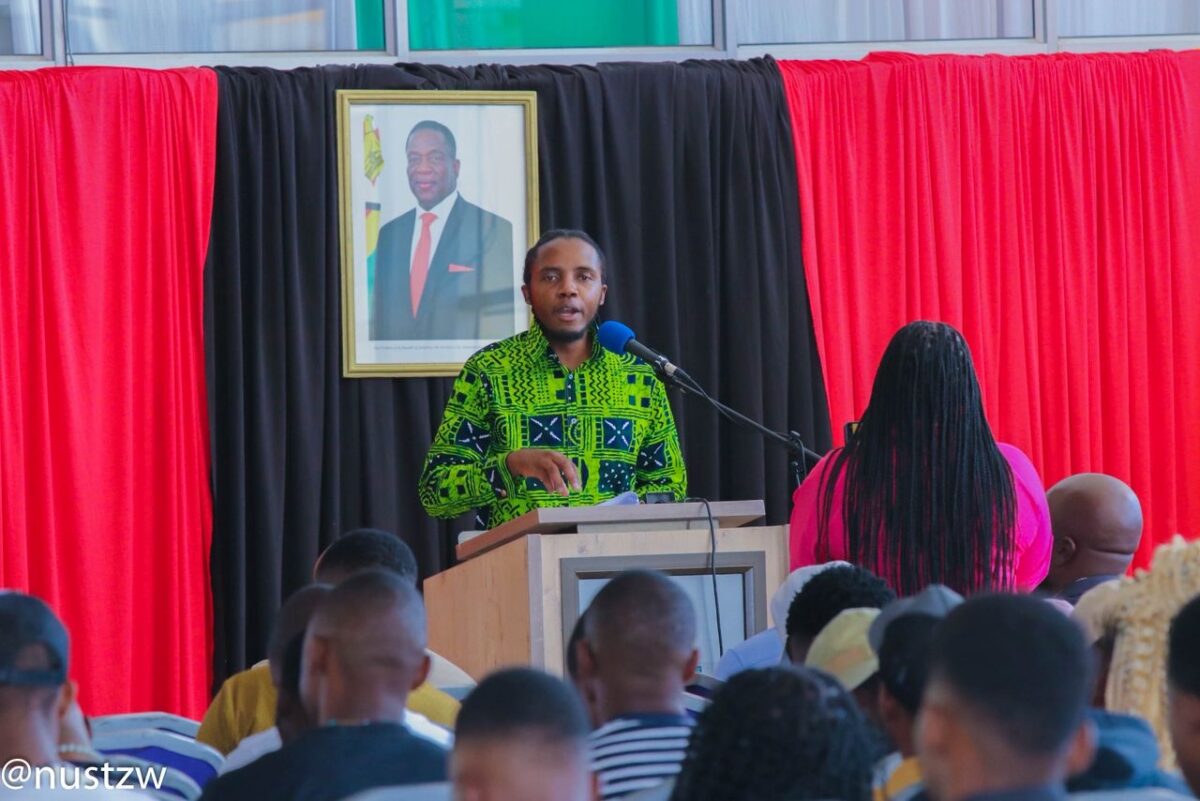
Transcript of a public lecture by Richard Runyararo Mahomva at the National University of Science and Technology on April 17, 2026, as prepared for delivery:
THE commemoration of this year’s independence anniversary marks a turning point in the revolutionary continuity of the Zimbabwean national question. Coincidentally, the nation finds itself entangled in a historic constitutional amendment dialogue. This national dialogue, which sits right at the centre of our national liberation celebrations, offers an introspection to assess the journey we have traversed in law-creation before and after Independence.
The creation of the law (constitutionalism) is as old as the existence of our nation, and the very contestations of what it means “to be or not to be a citizen.” This dichotomy of being has been explicitly articulated by Mamdani in his seminal work which discusses how the colonial legislative/legal architecture naturalised a system whereby the colonial settler minority became ontologically advantaged as ‘citizens’ whereas the rightful owners of the African continent were imaginatively framed as ‘subjects’.
In this book, Citizens and Subjects, Mamdani through a Ugandan perspective, frames colonial humanity as distinctly separated and differently protected by law.
As such, the violent settler/invader used the law to “civilise the self and uncivilise the (African) other”. It is that preconceived sense of colonial superiority which causes the law to make the settler minority a citizen and, ironically, the owner of the invaded land a subject. To dramatise this incongruity, Fanon describes colonialism as a process of making Africa a zone of non-being. In this connection, the whole infrastructure of the law under colonialism made Africans to negotiate their existence from a tragic point of inexistence.
Consequently, the right to exist (for the African as a subject) could only be determined through the ballot or the bullet. In other words, the subject at law is a non-entity. The African’s entitlement to being a genuine and equal human had and still has to be fought for. As a result, Fanon paints a picture of the Global South or dispossessed of our continent as the Wretched of the Earth.
Therefore, as we celebrate 46 years of rejecting the ontological tag of being subjects towards the aspirational call of being citizens, we must reflect on how the law has and is still being transformed to suit this cause. This is what informs the title of this lecture: ‘Zimbabwe at 46: Reflections on the Struggle to Deepen Electoral Democracy and Unthinking Constitutional Coloniality.’
Constitutions mediate define terms of who controls power and how that same power must be used. In other words, constitutions guide how state power is regulated and usually the regulators of state power are those who own that particular power in question. While the normative aspiration of the people is to have constitutions limiting the power of those in power, it has been evident across humanity that owners of state power – the politicians – use constitutions to entrench their interests. This constitutes what one may call constitutional realism and yet public aspirational desires to reduce the power of the powerful can be regarded as constitutional idealism.
Constitutional idealism also favours fundamental human rights which every constitution must have without fail. The difference between constitutional realism and constitutional idealism can be summarised as follows: Those in power want constitutions to guarantee the security of their stay in power while those without the same power preoccupy themselves with clauses which regulate power retention by state elites. As such, even the best constitutional amendments are usually described as “violations of people’s rights”, but is this entitlement entirely premised on truth or its merely normative?
As Zimbabwe celebrates 46 years of Independence, the nationalist movement must remember that its role of dismantling of colonialism was meant to return the power to the people. In fact, the mandate of our national liberators was that of ensuring that the law humanised power.
This means that the primary basis of constitutionalism in our case is to preserve the supreme gains of Independence more than anything else. These gains include total economic democratisation which dismantles White monopoly capital. As such, real post-colonial constitutionalism should be more focused on increased control of the economy by the people.
Contrary to the constitutional limitations of 1980, Zanu PF advanced various economic empowerment initiatives. This was a step further from the normative/idealist fixations of constitutionalism.
Whereas constitutional realism is focused on state power retention, Zanu PF over the years has added a new conceptual layer to this phenomenon as a conduit to the attainment of economic democratisation. This means that constitutional realism is not just about mere acquisition of power for the sake of power, but the acquisition of power for economic democratisation.
Therefore, the proposed electoral lifecycle from five to seven years guarantees the longevity of the sustained pro-majority economic growth. This also means rethinking durational terms of presidency from being an executive power capture exercise to setting a sustainable framework of keeping wealth in the hands of the majority under a leadership system which understands the importance of economic democratisation.
Zanu PF’s leadership continuity proposal from the party’s recent National People’s Conferences (2024-25) represents a more complex case of preserving the institutional existence of human the party than an individual who, on many occasions, has insisted that he “will persuade the persuaders not to persuade him” to stay in office beyond 2028.
Having articulated how the monumental proposal of Constitutional Amendment (No.3) Bill is underpinned on Zanu PF’s foundational principles to protect economic democratisation, it is important to also state that the expansion of the electoral circle stands to benefit opposition forces in Zimbabwe. An expanded electoral lifecycle gives time for the resurrection of our opposition. Across its decomposed institutional divide, the opposition is in need of recuperation.
CAB3 gives the opposition a second chance to resurrect itself, create structures and to compete for power with a semblance of institutional traction which Zanu PF currently possesses.
CAB3 enables the opposition to assume an organic form given that a majority of its external funding has been cut due to the West’s regime change fatigue in Zimbabwe. Therefore, an increase in the election preparatory period from five to seven years serves as a strategic moment for Zimbabwe’s bankrupt opposition bodies to develop local funding strategies for their cause. However, a stumbling block to this cause is the fact that the pro-Western functional rationality of our opposition (all MDCs to the CCC) was that of dissuading their supporters from taking part in the Land Reform Programme and mining sectors since 1999.
Meanwhile, Zanu PF was busy allocating land to the formerly disenfranchised African majority. Reciprocally, the beneficiaries of Zanu PF’s then economic empowerment initiatives are the owners of the country’s key means of production. This means that the realisation of an Upper Middle-Income Economy by 2030 is the only window through which the economic self-marginalised supporters of the opposition can develop an organic fundraising mechanism to support their aspirations to capture power from Zanu-PF’s land reform and mining sector millionaires.
Therefore, critics of CAB3 only think that the presidential term clause is about ambitious power retention interests and miss the fact that this proposal reinvigorates democracy as it gives a new lease of life to the country’s defunct opposition. Therefore, CAB3 is a fortune-bearer to the opposition and its existential tribulations since the days of the late Morgan Tsvangirai’s anti-land reform and pro-sanctions politics.
This is an important milestone in the history of our Independence as we are developing laws which are giving equal political privilege to a key section of our polity which committed a heinous crime of promoting the preservation of White economic control. After the failure to protect White land control, the opposition went further to call for the imposition of illegal sanctions on Zimbabwe. Decades later after being used and rejected by Western powers, subsequently losing substantial support from the country’s progressive voting majority and suffering continued factional decimation, CAB3 is the opposition’s timely panacea from its current miscellaneous troubles and problems.
The 1891 formalisation of law at the Cape of Good Hope’s applicability in Rhodesia as was carried to Section 89 of the Lancaster Constitution was about denying Africans the right to vote. Likewise, the legal instruments of the British South-African Company, Order(s) in Council of 1894 and 1898, respectively, were meant to perpetuate the colonial subjugation of the African people.
This explains why in 1922 only six out of a population close to a million Africans were allowed participation in the referendum which was in favour of the establishment of a ‘responsible government’ to facilitate the transfer of power from the British South-African Company (BSAC).
The ultimate result was the creation and adoption of the 1923 Constitution and the election of Charles Coghlan as Prime Minister through a parliamentary process in 1924.
At this point the colonial state’s denial of the African’s right to vote was very clear. The Bantu Rhodesian Voters Association’s basis for proto-nationalism alongside many other formations became very justified. Thereafter, the Land Apportionment Act of 1930 prompted the intensification of the nationalist cause, culminating in the formation of the ANC in 1934.
However, only 429 Africans qualified to vote in the 1953 referendum for the approval of Rhodesia and Nyasaland. The demand for universal suffrage continued to gain momentum, regardless of the colonial establishment’s resistance. In 1960, a new constitution was created though it was short-lived due to the rise of the Unilateral Declaration to Independence (UDI) in 1965. The legality of the UDI was contested by Daniel Madzimbamuto.
Meanwhile, Zapu and Zanu had been formed in 1960 and 1963, respectively. The sustained anger of the majority led to the armed struggle which was motivated by many structural inequalities and injustices.
The armed struggle was about deconstructing class-based eligibility to vote. The first realisation of the one man, one vote principle regardless of its patriarchal nomenclature and underpinning nuances was in 1980. Both men and women of our country voted as one constituency. Zanu had an overwhelming majority of the 100 seats in the first parliament. The result was the formation of the first ever Black-led government led by Prime Minister Robert Mugabe.
The 1985 and 1990 elections saw a rapid growth in our democracy which moved from 100 to 120 parliamentary seats. Fast-forward, we have 210 electoral constituencies, 60 women’s quota and 10 youth quota seats. This expanded parliamentary participatory base enhances the role of parliament as a law-making body. This is because the fundamental function of parliament is to make laws and shape what becomes constitutional from what is unconstitutional.
With the proposed amendment advancing the appointment of the president through a parliamentary vote, the aspect inclusive participation is enhanced since parliament is derived from the people.
Parliament as a source of electoral legitimacy has its candidates derived from poll-based elections. With this structural efficiency of our voting systems, it means political representation goes beyond the conventional and broad constituency system. This means that a constituency has various voting units, therefore underscoring the inclusivity and electoral accountability which the country has never experienced since 1922.
Therefore, the country’s march to a jubilee by 2030 would be benchmarked by a deepened electoral democracy.
While the central discursive pivoting of the CAB3 criticism has been anchored on the deployment of the One Man, One Vote affirmation, it is worth noting that this perspective is gender problematic.
The fixation on the “one man, one vote” discourse is patriarchally disenfranchising. It is inconsistent with the values of equality which the armed struggle endeavoured to deliver to the sons and daughters of the soils.
This masculine imagination voting exerts a false superiority complex of sons over the daughters of the soil. This misogynistic framing of electoral democracy denies women the status of being a rational constituency in the same way colonial patriarchy denied the Black body the right to dignity and, subsequently, the right to choose leaders.
The one man, one vote narrative in 2026 is oblivious of the equality of women in our politics. It places a superficial obligation to elect leaders on a single gender as if political participation is a “boys only thing”.
Going forward, patriarchy must take stock of the violence it has imposed on the other gender. This way, we will eject from our political vocabulary any inferences and insinuations of prejudice against women, particularly viewing them as a non-voting species.
Apart from ejecting the patriarchal sentiment to power, we must confront every idea which keeps us polarised and outward looking to shape our democratic courses of action. Perhaps as we celebrate Zimbabwe’s 46th anniversary, we must nudge our minds to unthink the coloniality of constitutionalism. This way, the post-Constitutional Amendment dispensation will be guided by values of a liberated nation championing its unprecedented economic liberation.
Richard Runyararo Mahomva is a public relations expert